


Custom Website Design vs Template-Based Design: What Businesses Should Consider

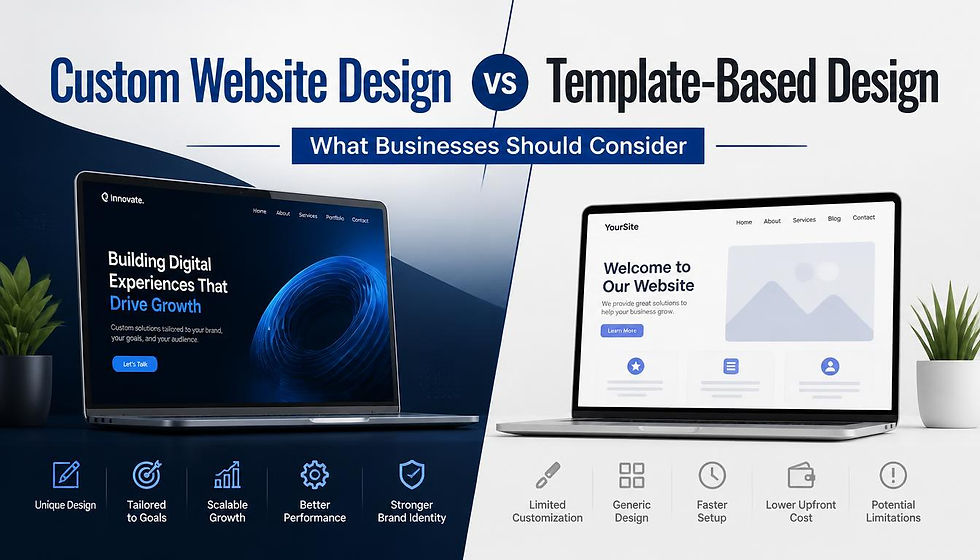
When creating a new website, businesses often face an important decision: should they use a ready-made template or invest in a custom website design?
Both approaches can be useful, but the right choice depends on the company's goals, audience, functionality, branding requirements, and long-term plans.
What Is Template-Based Design?
Template-based websites use pre-designed layouts that can be customized with a company's text, images, colors, and branding.
Templates can be useful when a business needs a simple website and wants to launch quickly. They can also reduce the amount of design work required during the initial setup.
However, templates may come with limitations. A business may need to change its processes or content to fit the available layout rather than designing the experience around its audience.
What Is Custom Website Design?
Custom website design starts with the specific requirements of a business.
Instead of relying entirely on a predefined layout, designers can create page structures, visual elements, navigation systems, and user experiences according to the company's objectives.
This can be particularly useful for businesses with unique branding or more complex requirements.
For example, a B2B company may need detailed service pages and lead-generation forms, while an online store may require product filtering, category pages, shopping functionality, and a streamlined checkout experience.
Branding Becomes Easier With Custom Design
A website should reflect the identity of the business.
Custom design provides greater flexibility over typography, colors, layouts, graphics, content presentation, and interactive elements. This can help businesses create a website that feels more consistent with their overall brand.
A distinctive website can also help visitors recognize the company across different digital channels.
User Experience Should Come First
A website should be designed around its users rather than only around appearance.
Custom design makes it possible to plan navigation and page layouts based on how visitors are expected to interact with the website.
Important information can be positioned where users are more likely to find it, while unnecessary elements can be removed.
Custom Design and SEO
Website structure can also affect how search engines and users understand a site.
A custom website can be planned with logical navigation, optimized page structures, mobile responsiveness, fast-loading elements, and SEO-friendly content organization.
This does not mean that a custom website automatically ranks higher. SEO depends on many factors, but a well-structured website provides a useful technical and user-experience foundation.
Choosing Professional Web Design Services
Businesses that are unsure which approach to use can begin by identifying their objectives.
Ask questions such as:
Who will use the website?
What actions should visitors take?
How many pages are required?
Does the business need e-commerce functionality?
Will the website need regular content updates?
Does the brand require a distinctive visual identity?
Will the website need to support future expansion?
The answers can help determine whether a simple template or a more customized solution is appropriate.
Professional web design services can cover different requirements, including custom website design, responsive design, WordPress websites, e-commerce interfaces, landing pages, and UI/UX design.
Ultimately, the goal is not simply to create a website that looks different. The goal is to create a website that communicates clearly, works smoothly, represents the brand effectively, and supports the business objectives.
For companies planning a long-term digital presence, these considerations should be addressed before the website is designed and developed.



Comments